
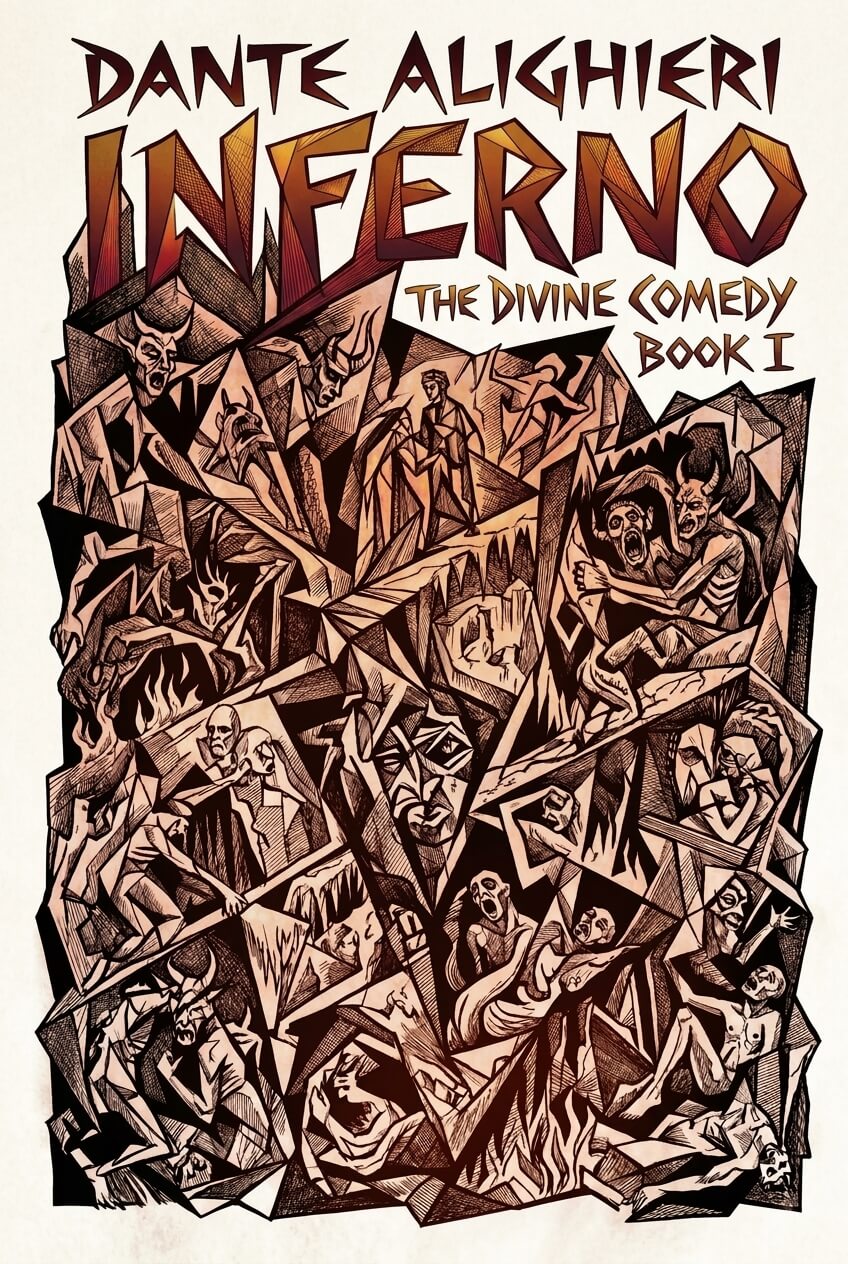

Dante Alighieri
Divine Comedy: Inferno
If you walked through hell, would you emerge unchanged—or would you recognize something of yourself in the flames?
This is the central question at the heart of Dante Alighieri's Inferno (c. 1321), the first and most famous canticle of his epic masterpiece, The Divine Comedy, and one of the most influential works in all of Western literature.
The poem begins on the evening of Good Friday in the year 1300, when Dante the pilgrim finds himself lost in a dark, tangled forest, terrified and alone, his path to salvation blocked by three terrifying beasts. Just as all hope seems lost, the spirit of the ancient Roman poet Virgil appears, sent by the blessed Beatrice to rescue him. Virgil offers Dante a way out: not by avoiding the darkness, but by passing directly through it. Together, they will descend into the underworld, traversing the nine concentric circles of Hell, each one reserved for a different category of sin, before eventually emerging into the light.
As the pilgrim descends deeper into the abyss, he is forced to witness the brutal consequences of human wickedness up close—sometimes with pity, sometimes with horror, and sometimes with righteous fury. Yet the journey is not merely a tour of terror. It is also a profound meditation on justice, love, and the nature of sin itself. Dante the pilgrim is challenged to understand why these souls are here, what choices led them to this fate, and what it truly means to be human in the face of divine judgment. Virgil serves as both guide and teacher, offering wisdom on morality, free will, and the structure of God's cosmic plan.
Brilliantly inventive, vividly grotesque, and deeply humane, Inferno poses timeless questions: What is the true cost of our choices? Can we recognize our own sins when we see them reflected in others? And is there hope for redemption even in the darkest places?
Inferno is not a poem that comforts—it unsettles. It holds a mirror up to the reader, forcing us to ask not only what we would do in Dante's place, but what we have already done in our own. By the final circle, you may find that the most terrifying demon is not lurking in the ice, but staring back at you from the page.